
Bench Press Strength Standards
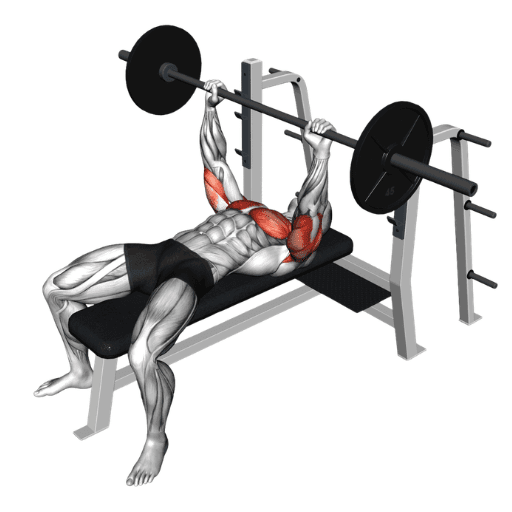
About the Bench Press
The barbell bench press is one of the most widely performed and measured upper-body strength exercises. It involves pressing a loaded barbell from chest level to full arm extension while lying on a flat bench. Biomechanically, it combines horizontal shoulder adduction and shoulder flexion with elbow extension—recruiting the pectoralis major (sternal and clavicular heads), anterior deltoids, and triceps brachii as prime movers, while the rotator cuff, latissimus dorsi, and scapular retractors stabilize the shoulder girdle.
In both clinical strength testing (NSCA) and competitive powerlifting (IPF), the flat barbell bench press serves as the primary upper-body pushing benchmark. For a valid comparison against these standards, repetitions should be performed raw (without bench shirts), lowering the bar to touch the lower chest and pressing to full elbow lockout while keeping the head, upper back, and glutes in contact with the bench.
How Much Should You Be Able to Bench Press?
The answer depends on your bodyweight, training experience, age, and sex. As a general coaching reference, the benchmarks below give a starting framework. The interactive tool above provides a more precise, bodyweight-class-specific assessment using data from Dr. Lon Kilgore.
Beginner Target (Male)
0.5× BW
Half your bodyweight for a single rep
Intermediate Target (Male)
1.25× BW
The benchmark most dedicated gym lifters aim for
Quick Reference by Training Level
| Level | Male (BW Ratio) | Female (BW Ratio) | Typical Experience |
|---|---|---|---|
| Beginner | 0.50× | 0.30× | Before structured training |
| Novice | 1.00× | 0.50× | 6–12 months training |
| Intermediate | 1.25× | 0.75× | 1–3 years training |
| Advanced | 1.50× | 1.10× | 3–5+ years training |
| Elite | 2.00× | 1.45× | 5+ years competitive |
These ratios are general coaching benchmarks derived from established strength training conventions (Kilgore & Rippetoe). The interactive tool above uses bodyweight-class-specific absolute values from ExRx.net, which account for the non-linear relationship between bodyweight and strength potential.
What Each Strength Level Means
How to interpret your strength classification, typical training experience at each stage, and what it takes to progress to the next tier.
Beginner
0–6 Months TrainingYou can control a loaded barbell through the full bench press range of motion with stable form. Strength at this stage primarily reflects your baseline neuromuscular capacity before structured training begins.
Training Focus: Learning proper scapular retraction, consistent bar path, and building confidence under the barbell. Strength gains come rapidly from nervous system coordination rather than muscle growth.
Novice
6–12 Months TrainingYou have built a meaningful foundation of pressing strength—benching your own bodyweight (men) or half your bodyweight (women) demonstrates consistent training and early muscle adaptation.
Training Focus: Simple linear progression—adding 2.5–5 lb (1.25–2.5 kg) every 1–2 weeks—is still effective. Focus on accumulating volume across 3–4 working sets of 5–8 reps while building chest, shoulder, and tricep mass.
Intermediate
1–3 Years TrainingThe standard benchmark for a dedicated gym lifter. Reaching this level shows consistent multi-year training, solid technique, and meaningful upper-body hypertrophy. Most serious recreational lifters converge around this range.
Training Focus: Weekly linear jumps stall; structured periodization becomes necessary. Alternate heavy strength days (4×3–5 @ 85% 1RM) with higher-rep volume days (3–4×8–10 @ 72–78% 1RM). Targeted accessory work for weak points is essential.
Advanced
3–5+ Years TrainingStandout pressing strength. You are among the strongest lifters in most commercial gyms. This level requires years of dedicated programming, careful fatigue management, and attention to recovery variables like sleep and nutrition.
Training Focus: Multi-week block periodization—cycling accumulation phases (higher-rep hypertrophy) into intensification/peaking phases (heavy doubles and triples). Press 2–3 times per week using bench variations (paused, close-grip, incline) to prevent overuse.
Elite
5+ Years CompetitiveExceptional strength typically seen in competitive powerlifters. Pressing double your bodyweight (men) or nearly 1.5× bodyweight (women) represents the top tier of raw bench press performance.
Training Focus: Progress is measured over months, not weeks. Most training stays at RPE 7–8.5 to manage fatigue. Prioritize 7.5–9 hours of sleep, adequate protein (1.6–2.2 g/kg/day), and scheduled deload weeks every 4–6 weeks.
Full Reference Tables
| Body Weight (kg) | Beginner | Novice | Intermediate | Advanced | Elite |
|---|---|---|---|---|---|
| 52 | 37.5 | 50 | 60 | 82.5 | 100 |
| 56 | 40 | 52.5 | 62.5 | 90 | 110 |
| 60 | 45 | 57.5 | 70 | 95 | 117.5 |
| 67 | 50 | 65 | 77.5 | 107.5 | 132.5 |
| 75 | 55 | 70 | 85 | 115 | 145 |
| 82 | 60 | 75 | 90 | 125 | 157.5 |
| 90 | 62.5 | 80 | 97.5 | 132.5 | 162.5 |
| 100 | 62.5 | 82.5 | 102.5 | 137.5 | 172.5 |
| 110 | 65 | 85 | 105 | 142.5 | 180 |
| 125 | 67.5 | 87.5 | 107.5 | 147.5 | 185 |
| 145 | 70 | 90 | 112.5 | 152.5 | 190 |
| 146+ | 72.5 | 92.5 | 115 | 155 | 192.5 |
All values are 1RM in kg. Source: ExRx.net, provided by Dr. Lon Kilgore, PhD. The “+” after the heaviest class indicates an open bodyweight category.
How to Progress Your Bench Press
Each stage requires different training strategies. Below is a practical roadmap covering frequency, programming approach, accessory selection, and recovery priorities for every transition.
Stage 1
Beginner → Novice
Frequency
3× per week full-body, pressing in every session
Sets & Reps
3×5 @ RPE 7–8, adding 2.5–5 lb (1.25–2.5 kg) every session
Key Accessories
- Push-ups (3×10–15) for motor pattern reinforcement
- Dumbbell bench press (3×8–10) for unilateral balance
- Face pulls (3×15–20) for shoulder health
Recovery & Fatigue Management
48 hours between pressing sessions. Priority: sleep 7–9 hours and eat in a modest caloric surplus with 1.6–2.0 g protein per kg bodyweight.
Stage 2
Novice → Intermediate
Frequency
3–4× per week, at least 2 bench sessions
Sets & Reps
4×5–8 @ 75–80% 1RM, weekly progression (+2.5 lb / 1.25 kg every 1–2 weeks)
Key Accessories
- Incline dumbbell press (3×8–10) for upper-chest development
- Tricep dips or close-grip bench (3×8–10) for lockout strength
- Barbell rows (4×6–8) for pressing stability
Recovery & Fatigue Management
Introduce light/heavy session structure. Program a deload week every 4–6 weeks at 60% volume. Sleep, nutrition, and stress management become measurably impactful.
Stage 3
Intermediate → Advanced
Frequency
4× per week, 2–3 dedicated pressing sessions
Sets & Reps
Periodized blocks—Accumulation: 4×8–10 @ 70–75%. Intensification: 5×3–5 @ 82–88%. Monthly progression.
Key Accessories
- Paused bench (3×3–5) to develop bottom-end strength
- Board press or pin press for mid-range and lockout sticking points
- Overhead press (3×6–8) for deltoid pressing power
Recovery & Fatigue Management
Block periodization with dedicated hypertrophy, strength, and peaking phases (4–6 weeks each). Track RPE/RIR to manage fatigue accumulation. Consider regular bodywork for pec and shoulder maintenance.
Stage 4
Advanced → Elite
Frequency
4–5× per week, pressing 2–3× with variation
Sets & Reps
Daily undulating periodization or conjugate-style variation. Heavy singles/doubles at RPE 8–9 once per week; volume work at 65–78%.
Key Accessories
- Close-grip bench, Spoto press, and tempo bench for specific weaknesses
- Weighted dips (3–4×6–8) for pressing carryover
- Rear delt and rotator cuff prehab (daily, 3×15–20)
Recovery & Fatigue Management
Progress measured over months, not weeks. Sleep 7.5–9 hrs, protein 1.6–2.2 g/kg/day. Scheduled deloads every 4–6 weeks. Competition peaking cycles of 8–12 weeks to express maximal strength.
How These Standards Are Derived
Transparency in methodology so you know exactly how your result is calculated. Every step is performed in your browser—no data leaves your device.
Bodyweight-Specific Classification
Rather than using simple bodyweight ratios, this tool uses absolute 1RM thresholds for each weight class. This matters because the relationship between bodyweight and strength is non-linear—a heavier lifter can typically press more in absolute terms, but their bodyweight ratio decreases. The ExRx.net tables (compiled by Dr. Lon Kilgore) provide specific 1RM thresholds at each published weight class.
| Weight Class | Beginner | Novice | Intermediate | Advanced | Elite |
|---|---|---|---|---|---|
| 80 kg (176 lb) | 50 kg | 64 kg | 86 kg | 111 kg | 140 kg |
| 90 kg (198 lb) | 55 kg | 71 kg | 93 kg | 119 kg | 149 kg |
Example: Adult male standards for two weight classes. Full tables available via the interactive tool. When your bodyweight falls between classes, linear interpolation is applied.
1RM Estimation — Epley Formula
When you enter a multi-rep set instead of a tested one-rep max, the tool estimates your 1RM using the Epley formula. This is one of the most widely validated prediction equations in strength research.
Epley 1RM Prediction Formula
1RM = W × (1 + R ⁄ 30)
W = weight lifted | R = reps completed
The formula is most accurate for sets of 1–10 reps. Prediction accuracy decreases with sets exceeding 10 reps. Your result is clearly labeled as an estimate when this formula is used.
Age Band & Sex Classification
Standards differ by sex and life stage. The ExRx.net dataset provides separate male and female tables across four age bands, reflecting known differences in peak strength timing and age-related decline:
Teen
14–17 yrs
Developmental
Adult
18–39 yrs
Peak strength
Middle-Aged
40–59 yrs
Gradual decline
Older
60+ yrs
Continued training
Each age band has its own set of thresholds for every weight class. An adult male and a 50-year-old male of the same bodyweight have different standards reflecting the physiological effects of aging on peak force production.
Biomechanical & Individual Factors
Standards provide a useful comparative framework, but individual bench press performance is influenced by several factors beyond training experience:
Arm Length & Torso Proportions
Longer arms increase the range of motion, requiring more work per rep. Barrel-chested lifters have a mechanical advantage.
Muscle Insertion Points
Where muscles attach to bone affects leverage. More distal pec insertions improve pressing mechanics.
Body Composition
At the same bodyweight, higher lean mass produces more force. Standards don't distinguish body fat percentage.
Arch & Technique
A legal bench arch reduces range of motion and improves leverage. Technique mastery accounts for meaningful performance differences.
These factors explain why two lifters with identical bodyweight and training history may fall into different strength categories. Use your classification as a motivational guide, not a rigid judgment.
Data Source
ExRx.net Weightlifting Performance Standards
Provided by Dr. Lon Kilgore, PhD
Based on competitive weightlifting and powerlifting classification systems from the 1950s to present. These are performance standards (expected capabilities at each training level), not population norms.
View Original SourceDataset version 2026.1. Data period: 1950s–present (accumulated). All calculations are performed in your browser. No personal data is collected or transmitted.
Frequently Asked Questions
Bench press strength standards are performance benchmarks that classify your one-rep max relative to your bodyweight, age, and sex. They are derived from accumulated competitive and training data spanning decades, not from population surveys or predicted models. The five levels — Beginner, Novice, Intermediate, Advanced, and Elite — correspond to expected capabilities at each stage of structured resistance training.
The standards used in this tool are provided by Dr. Lon Kilgore, PhD, via ExRx.net. They are based on nearly 70 years of accumulated performance data from competitive weightlifting and powerlifting classification systems dating from the 1950s to the present. They are not regression-derived or predicted — they represent observed performance at each training level.
No. These are performance standards, not population norms. They describe the performance expected at each level of training progression, not what the average untrained person can do. A 'Beginner' classification means the expected capability of someone who has not yet begun structured training but can perform the exercise correctly.
When your bodyweight falls between two published weight classes, the tool uses linear interpolation to estimate appropriate thresholds. If your bodyweight is below the lightest or above the heaviest published class, the nearest available class values are used, and this is clearly disclosed in your results.
The tool supports lifters aged 18 to 69, organized into four bands: 18–39, 40–49, 50–59, and 60–69. Each age band has its own complete set of bodyweight-specific standards that account for the natural changes in strength potential across the lifespan.
Yes. Switch to 'Best Set' mode and enter the weight and reps from your best recent set (up to 15 reps). The tool will estimate your 1RM using the Epley formula: 1RM = W × (1 + R/30). The result will be labeled as an estimate. For the most accurate assessment, use sets of 1–10 reps.
The 'Beginner' level (corresponding to ExRx's 'Untrained' classification) represents an individual who has not trained on the exercises before but can perform them correctly. It is the expected starting point before beginning a structured training program — not a judgment of overall fitness or ability.
Many online strength calculators use simple bodyweight multipliers (e.g., 1.0× bodyweight = Intermediate). This tool uses bodyweight-class-specific values derived from actual competitive performance data, which accounts for the non-linear relationship between bodyweight and strength. A 60 kg lifter and a 100 kg lifter have different standards rather than a single ratio applied to everyone.
No. All calculations are performed entirely in your browser using JavaScript. No personal data is collected, transmitted, or stored on any server. Your inputs may be saved to your browser's local storage for convenience, which you can clear at any time using the Reset button.
References & Research paper
- Kilgore, L. (2006). Weightlifting Performance Standards. ExRx.net. Based on nearly 70 years of accumulated competitive and training performance data.
- Epley, B. (1985). Poundage Chart. Boyd Epley Workout. Lincoln, NE: Body Enterprises. Used for submaximal 1RM estimation from multi-rep sets.
- Fleck, S. J., & Kraemer, W. J. (2014). Designing Resistance Training Programs (4th ed.). Human Kinetics. Chapters on strength classification and training progression.
- Rippetoe, M., & Kilgore, L. (2006). Practical Programming for Strength Training. Classification of lifters by training advancement and neuromuscular adaptation.
- LeSuer, D. A., McCormick, J. H., Mayhew, J. L., Wasserstein, R. L., & Arnold, M. D. (1997). The accuracy of prediction equations for estimating 1-RM performance in the bench press, squat, and deadlift. Journal of Strength and Conditioning Research, 11(4), 211–213. doi:10.1519/00124278-199711000-00001
- Schoenfeld, B. J., Ogborn, D., & Krieger, J. W. (2017). Dose-response relationship between weekly resistance training volume and increases in muscle mass. Medicine & Science in Sports & Exercise, 49(3), 661–667. doi:10.1249/MSS.0000000000001164
- National Strength and Conditioning Association (2016). Essentials of Strength Training and Conditioning (4th ed.). G. G. Haff & N. T. Triplett (Eds.). Champaign, IL: Human Kinetics. Google Books
Disclaimer
This tool is provided for educational and informational purposes only. The strength standards, training recommendations, and programming guidelines presented here are general references and are not a substitute for individualized coaching or medical advice. Consult a qualified strength coach or healthcare professional before beginning or modifying any training program, especially if you have pre-existing injuries or medical conditions. All calculations are performed in your browser; no personal data is collected or transmitted.